


If you’re filing your income tax in 2026, you’re filing for Year of Assessment (YA) 2025, and yes, there are meaningful updates you should know about.
The short answer: several reliefs have been expanded, some limits have been raised, a brand-new housing loan interest relief has been reintroduced, and a few reliefs have had their eligibility periods extended. However, the majority of core tax reliefs such as EPF contributions, lifestyle relief, and personal relief, remain unchanged.
Knowing what’s new and what’s stayed the same is equally important. Missing either can cost you money.
Key Takeaways
- Most core reliefs — such as personal relief, EPF, and lifestyle relief — remain unchanged from previous years.
- Several reliefs have been expanded or raised under Budget 2025, such as higher limits for education and medical insurance, increased OKU-related reliefs, and expanded categories for medical and lifestyle claims.
- A new housing loan interest relief has been reintroduced for first-time homebuyers who signed their SPA between 1 January 2025 and 31 December 2027
What Is Tax Relief? (Quick Refresher)
A tax relief reduces your chargeable income, which is the figure LHDN uses to calculate how much income tax you owe. The lower your chargeable income, the less tax you pay.
The Formula:
Total Income − Approved Tax Reliefs = Chargeable Income → Apply Tax Rate → Tax Payable
Tax reliefs are available to both salaried employees (who file Form BE) and self-employed individuals and business owners (who file Form B). They cover a wide range of personal and family expenses: insurance premiums, education, medical costs, lifestyle spending, savings contributions, and more.
You must have actually incurred the expense between 1 January and 31 December 2025 to claim it under YA 2025. Always keep your receipts, invoices, and supporting documents — LHDN may request them during an audit, and missing documentation can result in the relief being disallowed, plus penalties.
What Changed in Tax Reliefs for 2026 (YA 2025)?
Summary Table of Tax Reliefs YA 2025
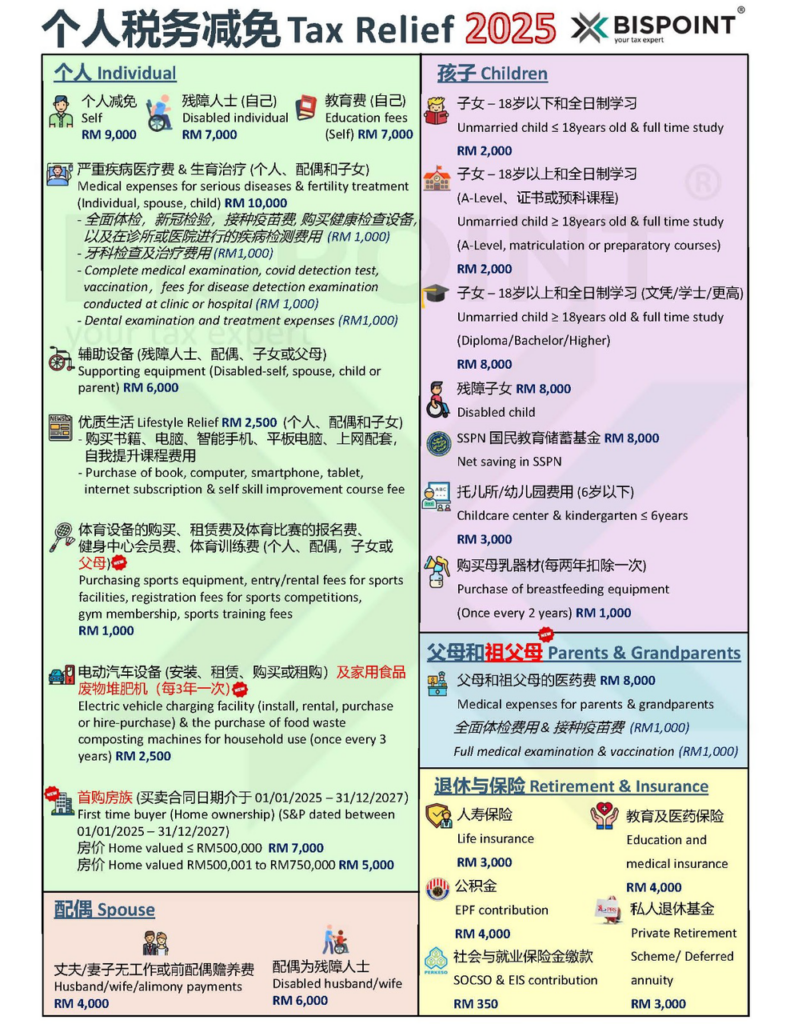
NEW Tax Relief: Housing Loan Interest Relief
For the first time since 2009, you can now claim tax relief on housing loan interest payments.
Who qualifies for the housing loan interest relief?
- Malaysian citizens buying their first residential home
- Sale and Purchase Agreement (SPA) signed between 1 January 2025 and 31 December 2027
- Property is not used to generate rental income
- Properties priced above RM750,000 do not qualify
How much can you claim?
| Property Price | Annual Tax Relief |
| Up to RM500,000 | RM7,000 per year |
| RM500,001 to RM750,000 | RM5,000 per year |
The relief is claimable for up to 3 consecutive years of assessment, starting from the year you first pay the housing loan interest. If the property is jointly owned, both parties may claim based on the proportion of interest each person pays.
For example: If you bought a RM480,000 home in 2025, paid your first instalment in YA 2025, and your interest payments were RM10,000 for the year, you can claim RM7,000 of that as relief in YA 2025, YA 2026, and YA 2027 (RM7,000 max in each YA).
INCREASED Tax Relief: Education & Medical Insurance Limit Raised to RM4,000
The cap on premiums paid for education and medical insurance (including Takaful) has increased from RM3,000 to RM4,000.
This covers insurance for yourself, your spouse, and your children, including:
- Medical cards and hospitalisation plans
- Critical illness coverage
- Group medical insurance where you pay the premiums
- Riders attached to life policies (critical illness riders claimable at 60%)
- Education insurance (child must be named beneficiary)
For example: If you’re paying RM350/month in medical insurance premiums for yourself and your spouse (RM4,200/year), you can now claim up to RM4,000 — an extra RM1,000 more than before.
Pro tip: You may obtain an insurance statement from the insurance company rather than assuming the premium payment is equal to the relief eligible.
INCREASED Tax Relief: Learning Disabilities Medical Relief Raised to RM6,000
Parents claiming medical expenses for children with learning disabilities (Autism, ADHD, Down Syndrome, and similar) can now claim a higher sub-limit of RM6,000 (up from RM4,000) for assessment, diagnosis, and early intervention expenses.
This sub-limit sits within the broader medical expenses relief cap of RM10,000, which also covers serious illnesses, fertility treatments, vaccinations, dental treatment, and mental health consultations. However, do note that the caps for vaccinations, dental treatment, and mental health consultations are RM1,000.
INCREASED Tax Relief: Disabled Person (OKU) Relief Higher Across All Categories
Fixed deductions for individuals registered with the Department of Social Welfare (JKM) as persons with disabilities have all increased:
| Category | Old Amount | New Amount |
| Taxpayer with registered disability | RM6,000 | RM7,000 |
| Disabled spouse | RM5,000 | RM6,000 |
| Disabled unmarried child | RM6,000 | RM8,000 |
Proof of JKM registration will suffice to claim this disabled person tax relief.
EXPANDED Tax Relief: Sports Relief Now Covers Parents Too
The RM1,000 sports relief has been expanded to include expenses incurred for your parents who are residents in Malaysia, in addition to yourself, your spouse, and your children.
Claimable sports expenses include:
- Purchase of sports equipment (rackets, dumbbells, yoga mats, etc.)
- Gym membership fees
- Rental or entry fees for sports facilities (badminton courts, swimming pools, bowling alleys)
- Registration fees for licensed sports competitions
- Sports training fees from registered associations or clubs
For example: If you paid RM800 for a gym membership that includes access for your parents, you can claim up to RM1,000 across the combined spending — just ensure activities are approved sport activities under the Sports Development Act.
EXPANDED Tax Relief: Medical Expenses Now Include Self-Test Devices & Screenings
The sub-limit for full medical check-ups, mental health consultations, and COVID-19 tests (previously capped at RM1,000 within the RM10,000 medical relief) has been expanded in scope to now include:
- Purchase of self-test kits (COVID-19, influenza)
- Purchase of self-testing medical devices: glucometers, pulse oximeters, blood pressure monitors, thermometers — registered under the Medical Devices Act 2012
- Disease detection screenings conducted at a clinic or hospital: blood tests, ultrasound scans, mammograms, pap smears
EXPANDED Tax Relief: Composting Machines Added To Hire-Purchase / EV Equipment Relief
The existing RM2,500 relief (claimable once every 3 years) for EV charging equipment and related purchases has been expanded to include household food waste composting machines — countertop or home appliances that convert kitchen scraps into compost.
This relief applies from YA 2025 to YA 2027, for non-business household use only.
Extended Tax Reliefs That Are Still Active (Don’t Miss Them!)
These reliefs are not new, but their eligibility periods have been renewed under Budget 2025.
| Relief | Maximum Claim | Extended Until |
| Nursery or Kindergarten Fees | RM3,000 | YA 2027 |
| SSPN (National Education Savings) Net Deposits | RM8,000 | YA 2027 |
| Private Retirement Scheme (PRS) Contributions | RM3,000 | YA 2030 |
Important note on SSPN from YA 2025 onwards: Only one parent may claim the SSPN relief per child (previously, both parents could claim separately). The claim is now based on net deposits — any withdrawals made in the same year must be deducted from the total deposited, except withdrawals made specifically for higher education purposes.
Tax Reliefs for 2026 That Remain Unchanged
The following reliefs carry the same limits as before, and represent the largest portion of most taxpayers’ deductions.
| Relief | Maximum Claim |
| Individual personal relief | RM9,000 |
| EPF contributions (employee mandatory/voluntary) | RM4,000 |
| EPF + Life Insurance (combined cap) | RM7,000 |
| Lifestyle relief (books, electronics, internet, sports equipment) | RM2,500 |
| Lifestyle relief – additional (sports equipment & facilities) | RM1,000 |
| Spouse relief (non-income-earning) | RM4,000 |
| Child relief (each child below 18) | RM2,000 |
| Child relief (each child in tertiary education) | RM8,000 |
| Parental medical treatment, dental, and care (including grandparents) | RM8,000 |
| Full medical check-up / mental health/vaccination (sub-limit) | RM1,000 |
| Total medical expenses for self, spouse, child, and fertility treatment | RM10,000 |
| Education fees (self-improvement, technical, vocational) | RM7,000 |
| SOCSO contributions | RM350 |
| EV charging facilities | RM2,500 |
How Tax Relief 2026 Affects You (By Scenario)
Scenario 1: Salaried Employee (No Children, Renting)
Your core reliefs (personal, EPF, lifestyle, insurance) are unchanged. If your insurance premiums were previously capped at RM3,000, the new RM4,000 limit gives you room to expand coverage without losing the relief. Focus on maximising EPF + insurance combined (RM7,000 total) and lifestyle relief (RM2,500 + RM500).
Scenario 2: Parents With Young Children
The extended kindergarten relief (RM3,000 until YA 2027) is still active — don’t assume it expired. If your child has a learning disability, the higher sub-limit of RM6,000 for assessment and intervention is a significant improvement. The SSPN relief is also still available at up to RM8,000, but remember: only one parent may claim per child now.
Scenario 3: First-Time Homebuyer (SPA Signed in 2025)
This is the year’s biggest change for you. If your property is priced up to RM750,000 and is not rented out, you can claim housing loan interest relief for up to 3 consecutive years of assessment. For an RM500,000 property, that’s up to RM21,000 in total relief across 3 years.
How to Maximise Your Tax Reliefs in 2026
- Start with the high-impact reliefs first
Prioritise the reliefs with the highest caps: EPF contributions (RM4,000), life insurance (RM3,000), medical expenses (RM10,000), education fees (RM7,000), and SSPN (RM8,000). These reduce chargeable income the most.
- Track receipts throughout the year, not at filing time
For YA 2026, which you’ll file in 2027, start keeping digital or physical records of your purchases from January 2026 onwards. Use your phone to photograph receipts immediately. LHDN audits can happen years after filing.
- Combine spousal and family reliefs strategically
If your spouse has no income, claim the RM4,000 spouse relief. Evaluate which parent should claim SSPN (only one can now). If both spouses pay insurance premiums, then who is the payor stated in the insurance statement who is eligible to claim the relief.
- Don’t overlook smaller reliefs
SOCSO contributions (RM350), the sports relief (RM1,000 + parents), and the composting machine relief (RM2,500 every 3 years) are frequently missed. Small amounts add up.
- If you bought your first home in 2025, file for the new housing relief
Ensure you have your SPA, loan agreement, and interest payment statements ready. This is a three-year relief, so claim it every year it’s eligible.
Common Mistakes to Avoid When Filing Your Taxes for YA 2025
- Assuming reliefs have changed when they haven’t. Many taxpayers skip claiming reliefs they’ve always had, fearing they’ve been removed. Unless there’s a confirmed Budget announcement, assume they’re still valid.
- Assuming reliefs are still active when they’ve actually been limited. The SSPN change is a good example — the relief is extended, but the rule that only one parent can claim per child is new. Couples claiming separately for the same child from YA 2025 onwards may face issues.
- Missing smaller relief categories. SOCSO, sports equipment, self-test medical devices, and vaccination costs are commonly overlooked.
- Not keeping proper documentation. Digital receipts are acceptable. Back them up. LHDN audits can occur up to 7 years after submission.
- Double-claiming reliefs on joint purchases. For jointly-owned properties, split claims must reflect actual proportions. For the new housing loan interest relief, each co-owner may only claim their share of interest paid.
FAQs: Tax Reliefs for 2026 Filing (YA 2025)
Q: When is the deadline to file my income tax in 2026?
For salaried individuals filing Form BE, the deadline is 30 April 2026, with an extended deadline of 15 May 2026 for e-Filing via the MyTax portal. For business income filers (Form B), the deadline is 30 June 2026, with an extended deadline of 15 July 2026 for e-Filing.
Q: I didn’t buy anything covered by lifestyle relief this year. Can I still claim it?
No. Tax reliefs are based on actual spending. You can only claim amounts you genuinely spent within the calendar year. Do not estimate or claim without documentation.
Q: Can both my spouse and I claim the SSPN relief for our child?
From YA 2025 onwards, only one parent may claim the SSPN relief per child. You and your spouse must decide who claims it.
Q: I signed my SPA in December 2024. Do I qualify for the housing loan interest relief?
No. The housing loan interest relief only applies to SPAs signed between 1 January 2025 and 31 December 2027. A December 2024 SPA does not qualify.
Q: I’m a freelancer. Are these reliefs available to me?
Yes. All personal tax reliefs discussed here are available to both salaried employees and self-employed individuals, as long as you are a Malaysian tax resident and the expenses were incurred within the YA 2025 calendar year.
2025 vs 2026 Comparison Table: Full Tax Relief List
| Relief Type | YA 2024 (Filing in 2025) | YA 2025 (Filing in 2026) | Status |
| Personal relief | RM9,000 | RM9,000 | ✅ Unchanged |
| Spouse relief | RM4,000 | RM4,000 | ✅ Unchanged |
| Child (below 18) | RM2,000 each | RM2,000 each | ✅ Unchanged |
| Child (tertiary education) | RM8,000 each | RM8,000 each | ✅ Unchanged |
| EPF contributions | RM4,000 | RM4,000 | ✅ Unchanged |
| Life insurance / Voluntary EPF | RM3,000 | RM3,000 | ✅ Unchanged |
| Education & medical insurance | RM3,000 | RM4,000 | ⬆️ Increased |
| Lifestyle (general) | RM2,500 | RM2,500 | ✅ Unchanged |
| Lifestyle – sports | RM1,000 additional | RM500 additional | ✅ Unchanged |
| Sports relief (RM1,000) | Self, spouse, children | Parents | ↔️ Expanded |
| Medical expenses (total) | RM10,000 | RM10,000 | ✅ Unchanged |
| Learning disabilities sub-limit | RM4,000 | RM6,000 | ⬆️ Increased |
| Self-test medical devices | Not covered | Covered | 🆕 New scope |
| Disease screening at clinic/hospital | Not covered | Covered | 🆕 New scope |
| Parental medical / dental / care | RM8,000 | RM8,000 | ✅ Unchanged |
| Disabled taxpayer (OKU) | RM6,000 | RM7,000 | ⬆️ Increased |
| Disabled spouse | RM5,000 | RM6,000 | ⬆️ Increased |
| Disabled child | RM6,000 | RM8,000 | ⬆️ Increased |
| Education fees (self) | RM7,000 | RM7,000 | ✅ Unchanged |
| SSPN net savings | RM8,000 (extended) | RM8,000 (to YA 2027) | 🔄 Extended |
| PRS contributions | RM3,000 (to YA 2025) | RM3,000 (to YA 2030) | 🔄 Extended |
| Nursery / Kindergarten fees | RM3,000 (extended) | RM3,000 (to YA 2027) | 🔄 Extended |
| Housing loan interest relief | Not available | RM5,000–RM7,000/year | ⬆️ New |
| EV / composting equipment | RM2,500 (EV only) | RM2,500 (+ composting) | ↔️ Expanded |
| SOCSO contributions | RM350 | RM350 | ✅ Unchanged |
| Foreign-sourced income exemption | Available | Available (to 2036) | 🔄 Extended |

