


Key Takeaway
Since 1 September 2026, Malaysian businesses with annual turnover or revenue below RM3 million are exempt from mandatory e-invoicing, provided they meet LHDN’s criteria. The exemption does not apply if a corporate shareholder, holding company, related company, or joint venture has turnover of RM3 million or more. Check your group structure before you stop issuing.
What Changed on 1 September 2026?
On 30 August 2026, in his National Day address, Prime Minister Datuk Seri Anwar Ibrahim announced that the e-invoice exemption threshold would rise from RM1 million to RM3 million. LHDN (the Inland Revenue Board of Malaysia, IRBM) confirmed the change the same day by releasing e-Invoice Guideline Version 4.8, with the new threshold effective from 1 September 2026.
The government estimates that more than 1.1 million businesses now fall outside mandatory e-invoicing. For many SMEs that were busy preparing for a 1 January 2026 or 1 July 2026 go-live, that is welcome news.
But it is not a blanket exemption. The rules on group structure, the timing for when you cross RM3 million, and the treatment of businesses that already started issuing e-invoices all matter. We cover each one below.
How the e-Invoice exemption threshold has moved
This threshold has changed several times. We will add a new row here each time LHDN updates it.
| When announced | Exemption threshold | Effective from |
| Earlier e-Invoice Guideline (2024) | Below RM150,000 | Original phased rollout |
| Budget 2025 (October 2024) | Below RM500,000 | Final phase of rollout |
| e-Invoice Guideline update (December 2025) | Below RM1 million | 1 January 2026 |
| National Day address and Guideline v4.8 (30 August 2026) | Below RM3 million | 1 September 2026 |
Source: LHDN e-Invoice Guideline v4.8, Section 1.6, and the LHDN e-Invoice General FAQs (updated 4 September 2026).
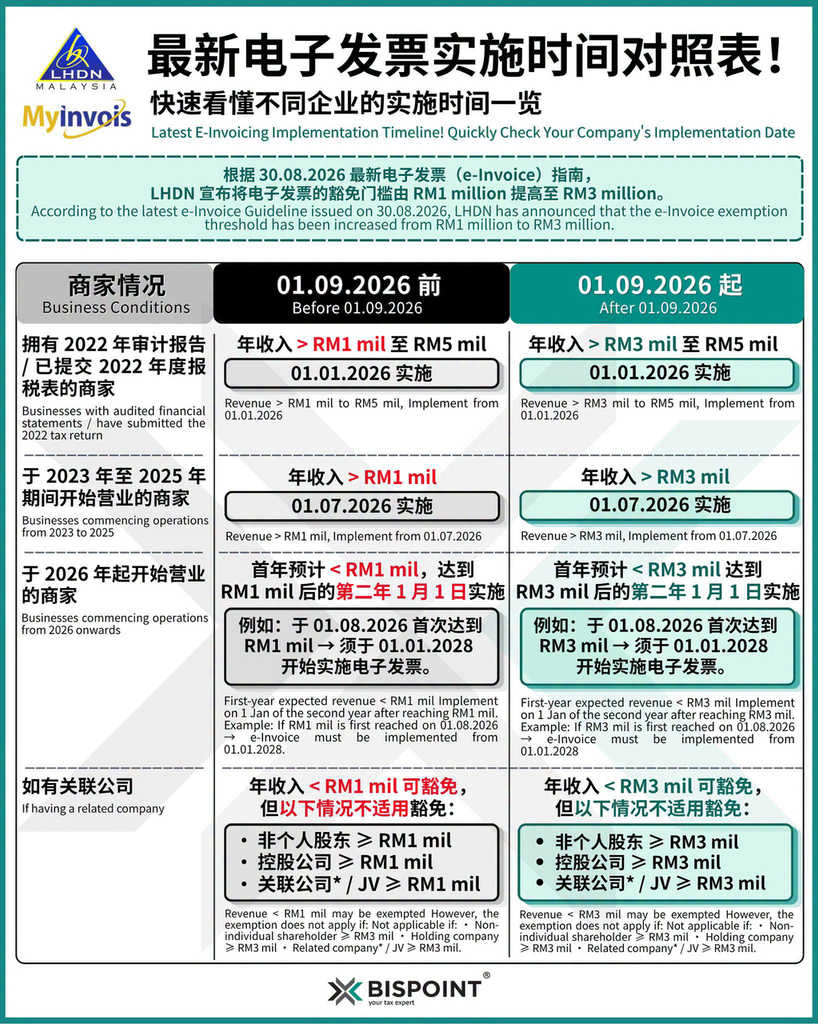
Your implementation dates: before and after 1 September 2026
| Your business situation | Before 1 September 2026 | From 1 September 2026 |
| In operation with a 2022 audited financial statement or 2022 tax return | Revenue above RM1m to RM5m: implement from 1 January 2026 | Revenue above RM3m to RM5m: implement from 1 January 2026 |
| Started operations between 2023 and 2025 | Revenue above RM1m: implement from 1 July 2026 | Revenue of RM3m or more: implement from 1 July 2026 |
| Started operations from 2026 onwards | Reach RM1m: implement from 1 January of the second year after that year | Reach RM3m: implement from 1 January of the second year after that year |
| Has a corporate shareholder, holding company, related company or JV | Exempt below RM1m, unless a group entity is at RM1m or more | Exempt below RM3m, unless a group entity is at RM3m or more |
Below RM3 Million Doesn’t Automatically Mean You’re Exempt
This is where many business owners get caught out.
Your revenue is only half the story. Who owns you, and who you own, matters just as much.
Under Section 1.6.10 of the e-Invoice Guideline, the exemption does not apply if any one of these is true, even when your own revenue is below RM3 million:
- You have a non-individual shareholder (for example, a company) with annual turnover or revenue of at least RM3 million.
2. You are a subsidiary of a holding company with annual turnover or revenue of at least RM3 million.
3. You have a related company or joint venture with annual turnover or revenue of at least RM3 million.
What counts as a “related company” for e-invoicing?
LHDN uses the meaning of “related company” in the Promotion of Investments Act 1986. In practical terms, the FAQs explain it like this:
- The 20% test. If one company holds at least 20% of the issued share capital of another company, the companies are treated as related.
- The control test. Even below 20%, companies are still related if the corporate shareholder actually controls the operations, for example through a shareholders’ agreement.
- Individual shareholders do not create a related-company link. If the same person owns two companies, those companies are not related for e-invoice purposes. This holds even if that person is also a director of both.
- A common director alone does not create a link. Having the same director in two companies, with no shareholding, does not make them related. LHDN looks at ownership and control at the shareholder level.
The simple way to think about it: corporate owners pull you into the group; individual owners don’t.
Is Your Business Exempt? 5 Questions to Self-Check
Answer these five questions in order. If you answer “No” to any of them, you are probably not exempt.
- Is your annual turnover or revenue below RM3 million? Use the revenue in your audited financial statements, or the revenue in your tax return if you are not audited. Sole proprietors must add up all businesses registered under their name.
- Are all your shareholders individuals? If a company holds shares in your business, check that company’s turnover.
- Is your holding company below RM3 million? If you are a subsidiary, your parent’s turnover counts.
- Are your related companies and JV partners below RM3 million? This includes sister companies owned by the same corporate shareholder.
- Has your mandatory implementation date been set because you reached RM3 million? If you already crossed RM3 million, falling back below it later does not bring the exemption back.
If you answered “Yes” to questions 1 to 4 and “No” to question 5, you are likely exempt. No application to LHDN is needed.
Exempt or Not? 7 Real-World Scenarios
These examples are based on the principles in LHDN’s e-Invoice General FAQs. Names are illustrative.
Scenario A: Standalone Sdn Bhd owned by individuals
Kedai Harmoni Sdn Bhd is owned by two individual shareholders. It has no corporate shareholders, subsidiaries, or JVs. Revenue in its latest financial year is RM2 million.
Verdict: Exempt. Revenue is below RM3 million, and there is no group link.
Scenario B: Same company, but with a corporate shareholder
Same facts as Scenario A, except that 30% of Kedai Harmoni Sdn Bhd is held by Harmoni Holdings Sdn Bhd, which has turnover of RM5 million.
Verdict: Not exempt. It has a non-individual shareholder with turnover of RM3 million or more. Its own RM2 million revenue does not help.
Scenario C: Small subsidiary of a larger group
Tunas Logistik Sdn Bhd has revenue of RM800,000. It is a wholly owned subsidiary of a holding company that already issues e-invoices, with turnover well above RM3 million.
Verdict: Not exempt. As a subsidiary of a holding company at or above RM3 million, it must implement e-invoicing. For companies in this position that were in operation before 2026, the implementation date is 1 July 2026. A new subsidiary that starts operations after that date must implement from its first day of operations.
Scenario D: Sole proprietor who was preparing under the RM1 million rule
Encik Hafiz runs a sole proprietorship with revenue of RM1.8 million, and his revenue has never reached RM3 million. Under the old RM1 million rule, his implementation date was 1 January 2026, and he had started issuing e-invoices.
Verdict: Exempt, and he can stop. LHDN’s FAQs confirm that businesses in this position may discontinue issuing e-invoices immediately. No application or approval is needed. He can also choose to carry on voluntarily.
Scenario E: Already mandated, then revenue drops
This one needs care, because the answer depends on why the business was mandated.
- E1: Mandated under the old RM1 million rule, revenue always below RM3 million. Seri Maju Sdn Bhd had revenue of RM1.5 million in 2022 and has stayed below RM3 million since. It began e-invoicing on 1 January 2026. Verdict: Exempt. Like Scenario D, it may stop immediately.
- E2: Mandated because revenue reached RM3 million, then dropped. Winner Agro Sdn Bhd crossed RM3 million in 2026, so its implementation date is 1 January 2028. In 2027, revenue drops to RM2.5 million. Verdict: Not exempt. LHDN is clear that once your mandatory implementation date has been set, the exemption is not granted again, even if revenue later falls below RM3 million.
In short, “once mandated, always mandated” still applies. However, it applies to businesses mandated because they actually reached the current threshold. It does not apply to those mandated only under the old, lower threshold.
Bonus scenario: Two companies, one owner
Mr. Lim owns 100% of Lim Trading Sdn Bhd (RM3.5 million revenue) and 100% of Lim Services Sdn Bhd (RM500,000 revenue).
Verdict: Lim Trading must implement. Lim Services is exempt. Because the common owner is an individual, the two companies are not related companies for e-invoice purposes.
Exempt, but a Customer Still Wants e-Invoices? What to Do
Being exempt on paper does not stop your customers from asking. Large companies that already issue e-invoices sometimes ask every supplier for one, or add extra paperwork before releasing payment.
Here is what the rules say:
- Your customer cannot force you to issue e-invoices. LHDN’s FAQs state that businesses that have implemented e-invoicing cannot compel suppliers who are not yet required to issue one. You may continue using your existing invoices and receipts.
- Your customer can still claim tax deductions. Buyers can continue to support deductions with existing documentation until the law is amended. Pointing this out often resolves the issue.
- You are not required to issue consolidated or self-billed e-invoices while you are exempt.
- If you sell on a local e-commerce platform, you still need to give the platform your details. The e-invoicing obligation for platform sales sits with the platform provider, not with you.
- If a key customer insists, you can choose to adopt e-invoicing voluntarily. The MyInvois Portal and MyInvois app are free, so a low-volume supplier can issue e-invoices without buying new software.
A short, polite note to your customer explaining that you are exempt under Section 1.6.10 of the e-Invoice Guideline is usually enough. We can help you draft one.
Should You Keep e-Invoicing Voluntarily Anyway?
LHDN encourages exempt businesses to adopt e-invoicing voluntarily. Whether that makes sense for you is a business decision, not a compliance one.
Reasons to keep e-invoicing or start now:
- Customer expectations. If most of your revenue comes from large corporates or GLCs, e-invoices can make you easier to deal with and may speed up payment.
- Growth plans. If you expect to cross RM3 million in the next year or two, starting early spreads the learning curve.
- Cleaner records. Structured digital invoices make bookkeeping, reconciliation, and audits smoother.
- Tax incentives. MSMEs can claim a tax deduction of up to RM50,000 per year of assessment for qualifying e-invoice consultancy and customised software costs (YA2024 to YA2027). Accelerated capital allowances are also available for qualifying ICT equipment and software.
- Future threshold changes. The threshold has moved four times. It could move again.
Reasons to wait:
- Cost and admin. Software, staff training and process changes take time and money.
- Low B2B exposure. If you mainly sell to individual consumers, the practical benefit is smaller.
- Group changes ahead. If a restructuring or new investor is on the horizon, your status may change anyway, so plan once.
What makes sense depends on your customers, your growth plans and your group structure. If you are unsure, talk it through with an adviser before you spend money on a system.
Key E-invoice Dates and What to Watch
| Date | What happens |
| 30 August 2026 | RM3 million threshold announced; e-Invoice Guideline v4.8 issued |
| 1 September 2026 | RM3 million exemption threshold takes effect |
| 9 October 2026 | Budget 2027 tabled. Watch for further e-invoice or SME changes |
| 31 December 2027 | Interim relaxation period ends for businesses with 1 January 2026 and 1 July 2026 implementation dates |
| 31 December 2027 | e-Invoice Special Voluntary Disclosure Programme (SVDP) closes |
| 1 January 2028 | Go-live for businesses that first reach RM3 million in 2026 |
Two points worth noting:
- If your revenue reached RM3 million in any year from YA2023 to YA2025, your implementation date was 1 July 2026. It has already passed. You are within the interim relaxation period, but you should be issuing e-invoices now.
- If you missed e-invoices you should have issued, the e-Invoice SVDP (7 July 2026 to 31 December 2027) lets you correct them voluntarily.
Frequently Asked Questions
Is the RM3 million threshold based on revenue or profit?
It is based on annual turnover or revenue, not profit. For audited businesses, LHDN uses the turnover or revenue in the statement of comprehensive income in the audited financial statements. If you are not audited, it uses the revenue reported in your tax return.
Example: A trading company with RM3.4 million in sales but only RM150,000 in profit has crossed the threshold. The low profit makes no difference.
Does the exemption apply to sole proprietors and partnerships?
Yes. The exemption covers all types of taxpayers, including individuals, sole proprietors, partnerships, companies and cooperatives. For sole proprietors, LHDN adds up the revenue of all businesses registered under the owner’s name.
Example: Puan Aini owns a bakery (RM1.2 million), a catering business (RM1.1 million) and a café (RM900,000). Each is below RM3 million on its own, but together they total RM3.2 million. She is not exempt.
If my turnover crosses RM3 million later, when do I need to start?
You must start on 1 January of the second year after the year of assessment in which your revenue first reaches RM3 million.
Example: A company with a 31 December year-end first crosses RM3 million in August 2026. Its YA2026 revenue exceeds the threshold, so it must implement e-invoicing from 1 January 2028. This gives you roughly a full year to prepare.
I have already set up an e-invoicing system. Should I stop using it?
You can stop, but you don’t have to. If your revenue is below RM3 million and you meet the exemption criteria, LHDN confirms you may discontinue issuing e-invoices immediately, with no application or approval needed. You may also continue voluntarily.
Example: A company with RM2 million revenue started issuing e-invoices on 1 July 2026. Its biggest customers now expect them. Keeping the system running avoids disruption, and the money already spent is not wasted.
Does the exemption cover self-billed e-invoices?
Yes. Exempt businesses are not required to issue self-billed e-invoices or consolidated e-invoices.
Example: An exempt sole proprietor who pays a foreign freelancer does not need to issue a self-billed e-invoice for that payment.
Do I need to apply to LHDN to be exempt?
No. There is no application or approval process. If you meet the criteria, you are exempt. Keep your financial statements, tax returns, and shareholding records on file so you can show why you qualify if LHDN asks.
Are two companies owned by the same person treated as related?
No, if the common owner is an individual. Related-company status comes from a corporate shareholder holding 20% or more, or having control. A shared director with no shareholding does not create a link either.
Example: Ms. Tan owns 80% of two companies and her husband owns the rest. She is a director of both. One company has RM4 million revenue and the other RM700,000. The smaller company is still exempt.
I was mandated from 1 January 2026 but never issued e-invoices. Will I be penalised?
If your revenue has stayed below RM3 million and you meet the exemption criteria, no. LHDN’s FAQs confirm that no compliance action or penalty will be imposed in this situation, and you do not need to join the SVDP.
What happens if I wrongly assume my business is exempt?
You could face penalties for failing to issue e-invoices. Under the Income Tax Act 1967, this can mean a fine of RM200 to RM20,000, imprisonment of up to six months, or both, for each offence. The most common mistake we see is overlooking a corporate shareholder or sister company. If you have any corporate link in your ownership structure, check it before you stop issuing.
Does the exemption change if I sell online?
Your exemption status stays the same, but you must still give your details to the e-commerce platform. The platform provider is responsible for issuing e-invoices for sales on its platform. For sales in your physical shop, the usual exemption rules apply.
Not Sure Where Your Business Stands?
Group structures, sister companies and shareholder changes make this more complicated than a single revenue number. Our team can review your ownership structure and give you a clear answer, with no jargon.

